


As part of the project titled “Cognitive-Behavioral Treatment of Violent Behavior for Schoolchildren,” supported this year by the Municipality of Novo Sarajevo, peer support groups have been established in two schools in the Sarajevo Canton.
These groups bring together children from the fifth to ninth grades with the aim of further informing group members about peer violence and taking measures within their schools to prevent violence among children and respond to incidents when they occur. Members of the peer support groups participate in workshops on various topics. Through ten workshops for peer educators, students learned about the importance and role of peer support, risk factors, as well as different forms of peer violence. To better understand the concept and seriousness of peer violence, and to gain insight into its prevalence in their schools, students created an anonymous survey and conducted research among their peers, through which they also learned the rules of surveying, analysis, and interpretation of results. The survey results show that most children in the elementary schools “Grbavica II” and “Čengić Vila I” have experienced some form of peer violence, while some have also been perpetrators. Students identified school restrooms and areas in and around the school that are not constantly supervised as the most dangerous locations. It was observed that children are not always ready to report violence to an adult (teacher, pedagogue, school principal…), which highlights the need for peer support programs in schools, through which victims of peer violence could report incidents to their peers more easily and quickly, and which would also work towards the prevention of peer violence.
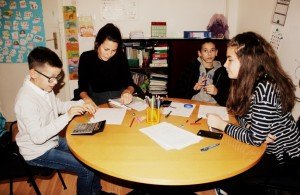
Students learned how and in what way to react in the event of peer violence, when it is permissible and safe to be a mediator in a peer conflict, and when it is necessary to inform adults. Skills of empathy, active listening, and assertiveness were practiced, with the aim of providing emotional support to victims of violence, while feelings of responsibility, justice, and positive values were developed. Through role-playing, students had the opportunity to put themselves in the role of the victim and better understand the feelings and state the victim is in, with the goal of developing empathy and a sense of responsibility for correct action.
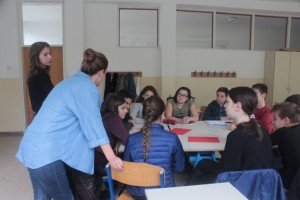
Skills for identifying various roles individuals assume in situations of group peer violence were developed.
The project is supported by the Municipality of Novo Sarajevo.